



Some years ago, the Peoples Democratic Party (PDP), which prided itself as the most populous party in Africa, though currently lying comatose, was literally mocked by many Nigerians, who changed the party’s official slogan derogatorily from “Power to the People” to “share the money”.
It was a slogan that aptly described the party’s governance style and philosophy. This was so because PDP thrived majorly in capturing the fancy of the poor Nigerian populace with mere tokenism, deceitfully branded and called “empowerment”.
It became fashionable then for political office holders, especially governors and lawmakers, to grandstand with different kinds of empowerment programmes.
So, it was not surprising that successive PDP governors in Abia took exceptional delight in sharing rice, wheelbarrows, wrappers, frying pans, sewing and grinding machines, tricycles, motorcycles, and tokunbo cars to their jobless supporters as empowerment. They also shared cash. And all of those translated to what was otherwise called “stomach infrastructure”. That was the best the administrations could offer the “poor masses” as their own dividend of democracy which, of course, did not endure.
For the PDP chieftains and godfathers, their own reward and dividend of democracy were entirely different. This category of Abia political class was placed on special stipends from Abia’s allocation.
So, rather than invest the Abia money in meaningful infrastructure, regular salary and pension payments, fixing the primary health centres and hospitals, as well as the schools and roads, it was frittered away through stomach infrastructure, “feeding bottles” and “blood tonic”.
But a major drain pipe through which Abia money got largely squandered was by underhand deals, politically baptised as party patronage. Under such arrangements, contracts for capital projects were awarded to party chieftains and godfathers. Regrettably, monies budgeted for such projects were scandalously shared amongst the “party leaders” and “power brokers”, while the projects remained either poorly executed, abandoned or not done at all. Instances of such government’s rascality abound between 1999 and 2023. One classical, instant example, indeed, was the case of the imaginary N10 billion Abia Airport.
When the lid was blown open regarding the non-existent airport, Abians, nay Nigerians, were stunned to hear that the whopping sum voted for the project was actually siphoned and shared by the then Gov. Okezie Ikpeazu and his co-travellers in PDP.
A forensic audit, commissioned by the administration of Gov. Alex Otti, revealed that the money was withdrawn from Abia’s account on September 25, 2020 and tagged “payment for 80 per cent contract of the Abia airport”.
The audit report further revealed that the funds were fraudulently “transferred to 32 different accounts”. That was the interesting story of the fictitious Abia Airport and the abracadabra by Nigeria’s Ambassador to Spain, ex-Abia Gov. Okezia Ikpeazu. In sane climes, Ambassador Ikpeazu and his partners-in-crime ought to be cooling off in detention, while investigations progressed.
But the good thing is that the matter is currently being handled and investigated by the Economic and Financial Crimes Commission and anybody who knows Gov. Otti can bet that there would be no sweeping the case under the carpet the Nigerian way. The money must be repatriated to the state treasury by all the crooks involved in the sharing, even if by plea bargain.
Ironically, the irrational money sharing mentality, unfortunately, took Abia nowhere for the 24 years of PDP in the saddle. It rather left the state with massive decay and huge deficit in basic infrastructure.
The tradition also explained the reason all the critical and economically strategic roads in the commercial city of Aba, such as Port Harcourt Road, Faulks Road, Cemetery Road, Ngwa Road, NNPC Depot Road, Osisioma and Ekeakpara Road, amongst others, suffered serious neglect in the hands of the three successive PDP administrations, until all the internal roads became impassable and completely closed to traffic for decades.
It was for the same lack of seriousness in governance and brazen misappropriation of public funds that inter-city and inter-state roads, connecting Abia with neighbouring states, collapsed completely and received no government’s attention.
In the same vein, government-owned schools, hospitals and health centres became pitiably dysfunctional, dilapidated and unfit for human use.
Above all, it was for the more than two decades of leadership failure, that Abia sank deeper into poverty and became a laughing stock as the poorest of the poor states in the country.
None of the projects, including the ones proudly referred to as “legacy projects”, coined to massage the ego of the ex-governors, outlived their respective eight-year tenures.
For instance, the roads built by Orji Uzor Kalu (1999 – 2007) in Aba and Umuahia were generally mocked as “China roads” because of their short lifespan. No sooner were they built than they failed and got washed off by rain, even before the end of his tenure.
His successor and godson, Ochendo Global, did practically nothing to address the dire infrastructure needs of Abia, particularly his ancestral Umuahia homeland.
Aside from the bifurcation of Bende Road, Akanu Ibiam/Government House Road and former Ossah Road (now expanded into six lanes with street lights either side, and rechristened Aguiyi Ironsi Boulevard by Gov. Otti’s government), Ochendo made no reasonable effort to give Umuahia aesthetic appeal befitting the status of a capital town.
Twice he made efforts to rehabilitate the Old Comfort Hotel axis on Aba Road, Umuahia, with huge budgets, and twice the project failed, leaving motorists with unforgettable nightmares during rainy seasons.
Again, once he tried to install traffic lights at the FMC/Akanu Ibiam Road Junction and Ikot Ekpene Road/BCA Road Junction, but the two projects appeared jinxed. They only blinked once and went blind permanently, even at great financial cost to the state.
Throughout his administration, roads in the small capital city were marked by a plethora of potholes. The few roads he built in Ugba-na-Nkata, his ancestral village, and a few Ibeku communities were ridiculously narrow and snaky, absolutely below acceptable construction standard anywhere in the world.
Ochendo’s “legacy projects”, especially the state Secretariat Complex and International Conference Centre – two laudable initiatives, no doubt, can best be likened to the Bible’s description of the “white sepulchre”. Apparently beautiful outside but substandard and scruffy inside.
Expectedly, Ochendo also bequeathed his successor, Ikpeazu, a malfunctioning system.
Unfortunately, Ikpeazu, who was notorious for being unserious in his official and personal capacities, turned out to become the worst governor Abia ever produced.
Many that were close to him said he did not disappoint the soothsayers, who rightly predicted that his administration would be worse than the two before it.
The embarrassing narratives regarding Abia’s development trajectory made Abians of goodwill to celebrate the outcome of the 2023 Governorship Election, which ousted PDP from the seat of power, as a divine answer to years of sustained prayers and supplications to God. Truly, the desire for change for a new and functional Abia, where the state resources should be religiously deployed into meaningful and sustainable development across various sectors, was deep and palpable.
That desire was the objective that clearly defines the God-sent administration of Gov. Otti which, from inception, designed a roadmap with a target that utterly and sharply deviates from the status quo.
That roadmap is profoundly about reclaiming the state from decades of ruins, in terms of fixing the roads, providing regular power for sustainable industrial growth and adequate security for lives and property, transformative reforms in the education and health sectors, and improved environmental hygiene, that should position Abia as potentially attractive to genuine local and foreign investors.
 It also aims to significantly improve the state’s human capital development index through a variety of youth entrepreneurship and ICT training programmes.
At the recent government-sponsored Abia State Roundtable discussion with the business community, mainly from the private sector, the governor took time to extensively dissect the reasons behind his government’s firm resolve to prioritise infrastructure development and de-emphasise the PDP’s stomach infrastructure. The theme of the meeting, which took place at the International Conference Centre, Umuahia, was “Where Vision Meets Enterprise”.
According to him, prioritising infrastructure development and pursuing business-friendly policies by his administration were intentional to attract private sector investment and stimulate Abia’s economic growth.
He recalled how empirical assessments carried out in the state identified poor road infrastructure as the major constraint to private sector participation, followed by security concerns, unreliable power supply and multiple taxation by government agencies.
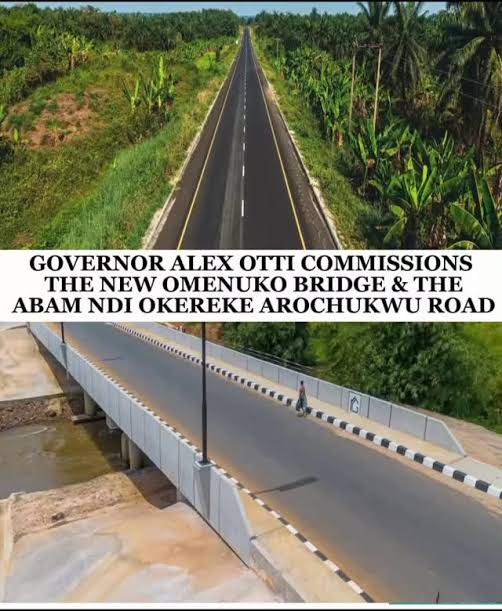
He said that his administration responded by launching an extensive road infrastructure restoration programme, beginning with economically vital areas of the state, especially in Aba.
He said that the initiative was necessary to encourage entrepreneurs and business owners, who have previously shut down operations or relocated, to reconsider returning to invest in the state.
The governor’s commitment to rebuilding Abia’s non-functional infrastructure apparently demonstrates his belief in the popular Chinese proverb, which says, “If you want to get rich, build roads first”.
The proverb is rooted in the understanding that transportation infrastructure “is the foundational key to unlocking economic development, trade, mobility, and prosperity, particularly for rural areas”. And without equivocation, the outcomes of the government’s focus on road infrastructure are beginning to shape the future of Abia, economically.
This is the reason Gov. Otti is not relenting or resting on his oars. He still remains absolutely committed to sustaining government’s intervention and investment in infrastructural overhaul for an expanded private sector ecosystem in the state.
For him, doing so means to attract entrepreneurs and corporate investors, create employment opportunities for young people and revive key economic assets in the state.
Little wonder why his humongous financial investment in quality, durable and well paved roads, primarily to improve connectivity, ensure smooth movement of goods and persons, achieve substantial reduction in accidents, travel time, and economic losses, have continued to receive widespread commendations.
Furthermore, the security architecture in Abia, under Gov. Otti’s watch, has been top-notch, boosting potential investors’ confidence in the state as an alluring, frontline investment destination in the country.
In a speech that frankly outlined the unfolding positives from the infrastructural revolution by Gov. Otti’s administration, a former Nigerian Ambassador to Singapore, Amb. Nonye Rajis-Okpara, confirmed that “international investors are beginning to show interest in opportunities in Abia”.
Rajis-Okpara, who spoke at the Umuahia roundtable interaction, expressed the confidence that stronger collaboration between government and investors would accelerate the state’s economic transformation.
This summation is not only heartwarming but also a profound indication that the Otti-led government is on the right course. It is also a prophecy that points to a future with greater opportunities and, ultimately, beckoning on Abia to maximise her full potentials for greatness and a leading commercial and industrial giant in Africa. To God be the glory!
- *Eagle Okoro is a public affairs analyst and writes from Umuahia.