


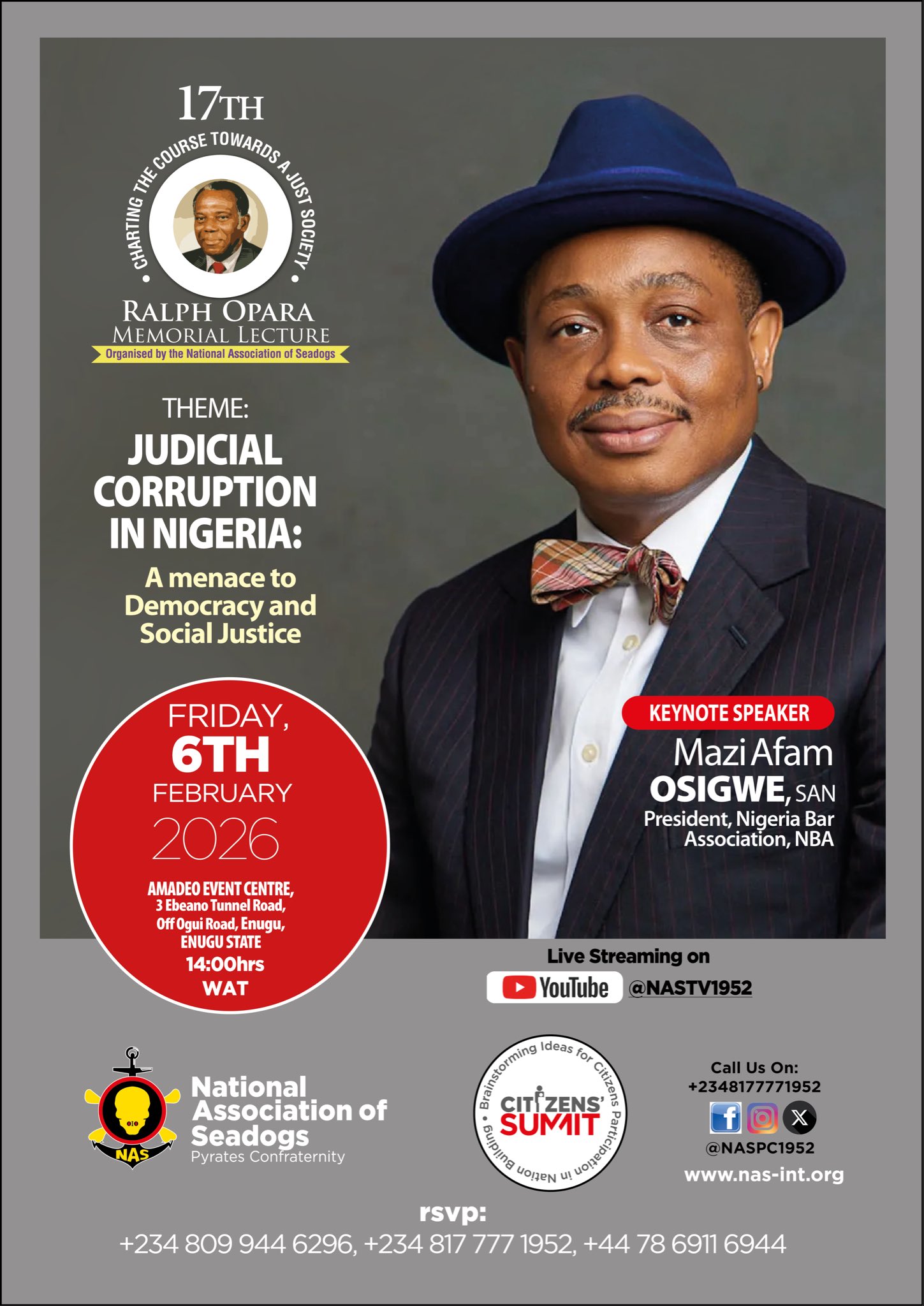
THE President of the Nigerian Bar Association (NBA) Mazi Afam Osigwe(SAN), has advised religious organisations and traditional institutions neither to give a place of honour to individuals whose sources of wealth are suspect, nor confer them with traditional titles.
The NBA president gave the advice on Friday, February 6, in Enugu, the Enugu state capital, while delivering the 17th Ralph Opara Memorial Lecture with the theme ‘Judicial Corruption In Nigeria: A Menace to Democracy and Social Justice,’ organised by the National Association of Seadogs (NAS).
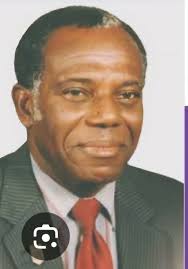
Late Raiph Opara, a seasoned broadcaster, was a one time director, Federal Radio Corporation of Nigeria(FRCN), Enugu zone, and one of the founding fathers of NAS.
The NBA boss described the title of the lecture as apposite, saying that many Nigerians have steadily lost confidence in the judicial system as it has been widely perceived as being riddled with corruption, inconsistency, and undue influence.
He said: “Judicial corruption is a significant social malaise in Nigeria, affecting the judiciary, governance, and economic development. It erodes public trust in the legal system, leading to a culture of impunity and disillusionment among citizens.
“The judiciary, which ought to be the last hope of the common person, is increasingly seen as an arena where justice can be delayed, manipulated, or out rightly purchased by the highest bidder. This perception has not arisen in a vacuum; it is rooted in repeated instances and
The legal luminary regretted that judicial corruption has persisted despite stiff stipulations in both the 1999 Constitution of the Federal Republic of Nigeria (as amended) and the Code of Conduct Bureau, criminalizing corruption.
He said: “Judicial corruption in Nigeria remains a pervasive issue, undermining public trust in the legal system and hindering the administration of justice. It manifests in forms such as bribery, political interference, nepotism, and manipulation of court processes, often involving judges, lawyers, court staff, and litigants.
“Whatever form it takes, judicial corruption strikes at the very heart of the rule of law. Yet, when justice becomes a commodity traded in the shadows of chambers and corridors, when rulings are allegedly influenced by envelopes rather than evidence, when adjournments are engineered for personal gain rather than procedural necessity, then the judiciary ceases to be the last hope of the common man and becomes instead the first refuge of the powerful and the corrupt.
 “
“
Late seasoned broadcaster, Ralph Opara
“That corruption has eaten deep into the fabric of the legal profession and indeed into the administration of justice is a readily admitted fact. This has been variously admitted by the bar and the bench.”
For example, “On February 17, 2012, the then President of the Nigerian Bar Association, J.B. Daudu (SAN) accused senior lawyers and retired judicial officers in the country of aiding and abetting corruption in election petitions. He made the allegation while speaking at the valedictory session held in honour of the late Supreme Court Justice, Anthony Aniagolu. J. B. Daudu (SAN) specifically said some senior lawyers and retired judicial officers serve as bribe couriers between politicians and election petition tribunals.
“… “Sadly it is no longer a moot point that the corruption that encompassed the larger society has infiltrated the justice sector. I make no distinction here between the Bar and the Bench. Corruption is now a live issue that is threatening to tear apart the foundations and fabric of the society.
“We are no doubt aware that some of our colleagues including very Senior counsel and at times eminent retired judicial officers go about offering their services as consultants particularly in election cases for incredible sums of money so as to act as conduit between their client and the election court. The end result is to facilitate ready-made justice for persons they are acting for. We must strongly deprecate this practice”.
According to the 2024 survey by United Nations Office on Drug and Crimes (UNODC) and the National Bureau of Statistics (NBS), Nigerian public officials received approximately N721 billion (about $1.26 billion at the time) in cash bribes in 2023, with judges ranking among the top recipients.
That’s not all. According to Chatham House, “Corruption is central to Nigeria’s challenges with insecurity, injustice, inequality and poor public goods and services. Amid consistently low levels of public spending, the misappropriation of those scarce public funds is causing real harm to citizens. This situation is worsened by a weak and compromised judicial system that allows elites to insulate themselves from accountability”
The NBA boss reminded his audience consisting of lawyers, business men, civil society organizations, journalists, that “separate Independent Corrupt Practices and Other Related Offences Commission (ICPC) survey from 2018-2020 estimated that around N9.4 billion was involved in bribes within the justice sector alone, with lawyers being the primary bribe-givers (27%), followed by litigants (22%) and court staff (22%).”
He continued: “Foreign perception is equally damning, as a Chatham House study found that 61% of Nigerians believe judges are likely to accept bribes, exacerbated by sociopolitical factors like executive interference and a lack of transparency in judicial appointments.
“In the light of these disturbing realities, it is evident that judicial corruption in Nigeria is no longer a matter of isolated misconduct, but a deep-seated systemic challenge that threatens public confidence in the administration of justice,” said the NBA president.
Arguing that Democracy thrives on the rule of law, and that elections, governance, accountability, and the peaceful resolution of disputes all depend on an independent and incorruptible judiciary, he submitted that “Judicial corruption is a direct and insidious attack on democracy.”
However, the NBA president expressed happiness that the NJC had at various times recommended the suspension, dismissal or compulsory retirement of judges for corrupt practices or age falsification and for gross misconduct.
He said that corruption persists and reigns supreme in Nigeria because persons in authority have either been corrupted by the system or by the people they come in contact with.
“If the people unanimously choose not to influence the work of public officers, indeed, the corrupt public officers cannot continue to operate without being exposed. Therefore, there are “corruptors” and “corruptees”, he said.
He advised Judicial Officers to reject every inducement, no matter how subtle or disguised, and report misconduct, whether by colleagues, court staff, or lawyers, swiftly and fearlessly to the National Judicial Council (NJC).
In hi s view, For the Judiciary to play its role in the fight against corruption, it must be independent and free from any form of interference or influence in terms of funding, political manipulation e.t.c.
Also, the Courts must ensure that cases bordering on corruption are dealt with expeditiously to instill public confidence in the fight against corruption.
THE ROLE OF THE CITIZENS
He urged citizens not to participate in corrupt practices, saying that Judicial corruption often thrives through everyday interactions, which include offers of bribes to influence outcomes, the use of intermediaries to “fix” cases, or the expectation that justice must be paid for.
“We also have a duty to report acts of judicial misconduct. Mechanisms exist within the National Judicial Council, the Legal Practitioners Disciplinary Committee, anti-corruption agencies, and civil society organizations for lodging complaints and petitions, and we must raise awareness and engage in public education and advocacy, through civil society organizations, the media, and community groups and associations,” he suggested.
The NBA boss concludes that the hope of the common man “will continue to wane in the justice delivery system if we do not fix it.”
According to him, combating judicial corruption is essential for restoring public faith in the legal framework and ensuring a fair and equitable justice.
He advised religious organisations and traditional institutions to carry out and sustain rigorous public enlightenment campaign against economic and financial crimes within and outside Nigeria, adding that they should neither give a place of honour to individuals whose wealth are of doubtful origin nor confer them with titles.
“They should speak out and condemn corruption and corrupt practices. They should not celebrate those who have plundered our national resource. They must ensure that they are given a place of dishonour in their organisations or institutions,’ Osigwe maintained.
Speaking earlier, NAS Capn, Dr. Joseph Oteri, said the gathering was not only meant to remember Ralph Opara, but also to reaffirm the values he lived, and stood for, which according to him are truth, courage, accountability and social justice.
“This memorial lecture serves both to preserve his influence in national conversations, and to commemorate Ralph Opara’s bold contributions,” said Dr. Oteri.