Sunday, September 13, 2026
No menu items!
Home Blog Page 6

Umahi casts ballot, pledges youth, infrastructure development. -From- Paulinus Ogbonna

Mr Osborne Umahi, APC chairmanship candidate in Ohaozara, cast his ballot Saturday, expressing optimism of victory and pledging youth and infrastructure development.

Umahi, son of the Minister of Works, Chief David Umahi, voted at about 11:36 a.m. at Onu-Ofukuru Polling Unit, Uburu, Ohaozara Local Government Area of Ebonyi.

He was accompanied to the polling unit by his mother, Mrs Rachel Umahi, wife of the Minister of Works.

The polling unit has 1,200 registered voters.

Speaking with journalists after casting his ballot, Umahi expressed satisfaction with the peaceful conduct of the election and urged voters to remain peaceful and law-abiding.

“I am delighted with what I have seen here. The election is peaceful, orderly and transparent, and I believe this is what democracy should be about,” he said.

Umahi expressed confidence that the APC would emerge victorious, saying: “I am optimistic of a landslide victory because the people have shown tremendous support for our party.”

He said his administration, if elected, would prioritise youth empowerment and infrastructure development.

“Two areas that will form the cornerstone of my administration are youth development and infrastructure,” he said.

According to him, the council needs programmes that will equip young people with skills, create opportunities and enable them to contribute meaningfully to the development of Ohaozara.

“We will give our youths the opportunity to participate actively in the development of our local government. They are not just the leaders of tomorrow; they are important stakeholders today,” he said.

On infrastructure, the APC candidate pledged to pursue projects that would improve living conditions and stimulate economic activities across the council.

“We will focus on infrastructure that has direct impact on the people and supports economic growth in our communities,” he said.

Umahi commended voters for turning out to exercise their franchise and urged political actors and supporters to accept the outcome of the election in the spirit of democracy.

“I appeal to everybody to remain calm and law-abiding. At the end of the day, the will of the people must prevail,” he said.

The election is being conducted across Ebonyi State to elect chairmen and councillors for the state’s local government areas.

The newly elected chairmen are expected to be sworn into office on Sept. 1.

Umahi’s voting at Onu-Ofukuru came amid increased political activities across Ohaozara, with voters exercising their franchise in the local government election.

Enugu Water Corporation Announces Temporary Disruption in Water Supply in Parts of Metropolis


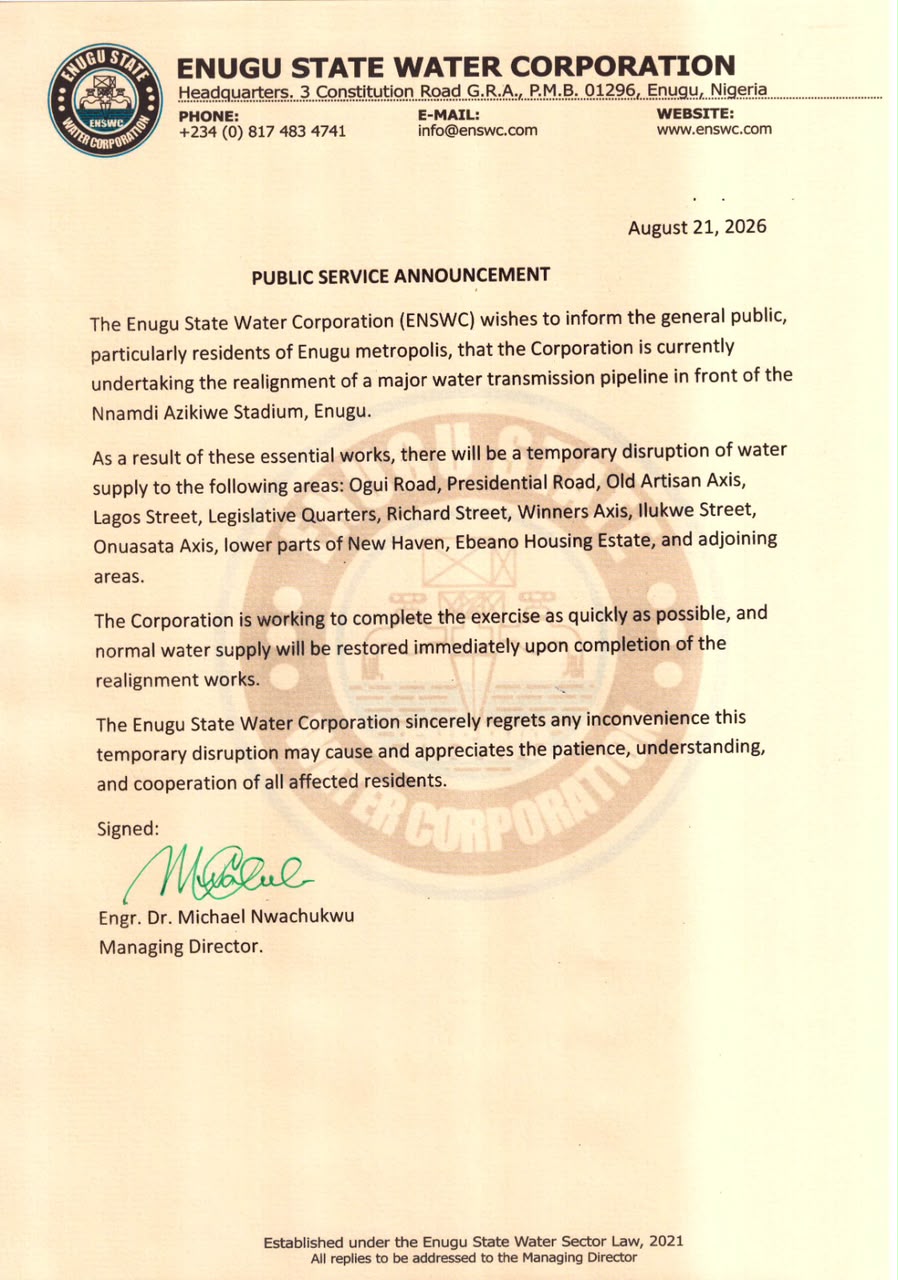
The Enugu State Water Corporation (ENSWC) has announced a temporary disruption in water supply to parts of Enugu metropolis as it undertakes the realignment of a major water transmission pipeline in front of the Nnamdi Azikiwe Stadium.

In a public service announcement dated August 21, 2026, the Corporation said the ongoing work was necessary to improve and maintain the state’s water transmission infrastructure.

According to the statement signed by the Managing Director of ENSWC, Dr. Michael Nwachukwu, the affected areas include Ogui Road, Presidential Road, Old Artisan Axis, Lagos Street, Legislative Quarters, Richard Street, Winners Axis, Ilukwe Street, Onuasata Axis, lower parts of New Haven and Ebeano Housing Estate, as well as adjoining areas.

The Corporation explained that the disruption would be temporary, stressing that its technical team was working to complete the realignment exercise as quickly as possible.

“Normal water supply will be restored immediately upon completion of the realignment works,” the statement said.

ENSWC expressed regret over the inconvenience the temporary disruption may cause residents and appealed for their patience, understanding and cooperation while the essential works are being carried out.

The Corporation reaffirmed its commitment to ensuring efficient and reliable water supply across Enugu metropolis and improving the state’s water infrastructure.

2027: Obi reiterates consumption to production, Says “no nation can import its way to prosperity.”

0


THE Presidential Candidate of the Nigerian Democratic Congress (NDC), Peter Obi, says Nigerians must produce more of what they consume, as well as process more of what they produce, so as to compete more effectively in the global markets

Obi made this declaration today in Onitsha, Anambra state, the commercial hub of the South-East, during a press conference to kickstart his 2027 electioneering campaign.

The NDC presidential flagbearer disclosed   that his campaign will serve as a national dialogue focused on rebuilding Nigeria.

Speaking on each sector of the economy, the former Anambra state governor, stated that thiugh he and his running mate, Rabiu Kwankwaso, come from diverse backgrounds and experiences, both share a common goal – “to improve the living standards of the impoverished among us.”

He said: “Our experiences differ, but our conclusion is clear: Nigeria must invest in its people and manage its public resources responsibly.”

On building an economy that works, Obi asserted that “Nigeria needs more than mere reactive reforms. The real questions are: Are Nigerians better off than they were four years ago? Can they afford food, education, and healthcare? Can businesses grow, produce, and generate jobs? Can young people secure productive employment? Can farmers work safely and get their produce to market?”

He urged citizens to seek direct answers from leaders, not through proxies or surrogate.

AFRAA Welcomes Enugu Air, Strengthens Nigeria’s Domestic Aviation Growth


The African Airlines Association (AFRAA) has admitted Enugu Air as Member, extending the Association’s membership base in Nigeria’s fast-growing domestic aviation market and reaffirming AFRAA’s commitment to supporting the continued development of African carriers across the continent.

This was announced by AFRAA in Nairobi on Wednesday, making Enugu Air the 50th Member of the association, joining the AFRAA airline fraternity, collectively representing more than 85 per cent of total international traffic carried by African airlines.

Speaking on the occasion, AFRAA Secretary General, Mr. Abdérahmane Berthé, said, “We are delighted to welcome Enugu Air into the AFRAA fraternity.

“As a state-backed carrier serving Nigeria’s rapidly expanding domestic market, Enugu Air represents the kind of homegrown investment that is vital to building resilient air connectivity across our continent.

“We look forward to supporting the airline through the IOSA certification process and to its continued growth within the AFRAA membership, as we work together to advance the cause of unified African skies.”

Reacting to the development, the CEO of Enugu, Capt Tolu Ita, described the admission into AFRAA as a major milestone in the airline’s short history.

“We are honoured to join the AFRAA fraternity. This membership underscores Enugu Air’s commitment to safe, reliable, and affordable air travel for Nigerians while contributing to the vision of a unified African aviation market.

“We look forward to collaborating with fellow AFRAA members and leveraging the association’s support as we grow our network and pursue IOSA certification,” Tolu stated.

Founded on July 7, 2025, Enugu Air commenced commercial operations with a fleet of Embraer E170/E190/E195 aircraft.

The airline, which has its headquarters in Enugu and operates from the Akanu Ibiam International Airport, currently serves nine domestic destinations including Enugu, Abuja, Lagos, Port Harcourt, Kano and Benin City.

As part of the airline’s growth strategy, Enugu Air plans to expand further across Nigeria and, in subsequent phases, to launch regional and international routes across Africa, Europe, and beyond.

As part of its growth strategy, Enugu Air plans to expand further across Nigeria and, in subsequent phases, to launch regional and international routes across Africa, Europe, and beyond.

The admission of Enugu Air aligns with AFRAA’s strategic priorities and strengthens the voice of the association. Nigeria, as Africa’s most populous nation and one of its fastest-growing economies, remains central to the realization of a truly integrated African aviation market.

Meanwhile, founded in Accra, Ghana, in April 1968, and headquartered in Nairobi, Kenya, AFRAA’s mission is to promote, serve African Airlines and champion Africa’s aviation industry.

The association envisions a sustainable, interconnected and affordable air transport industry in Africa, where African airlines become key players and drivers of African economic development.

AFRAA membership cuts across the entire continent and includes all the major intercontinental African operators.

The association’s members represent over 85% of total international traffic carried by African airlines.

Gov. Mbah Appoints 23 Advisers, Assistants to Strengthen Enugu Government


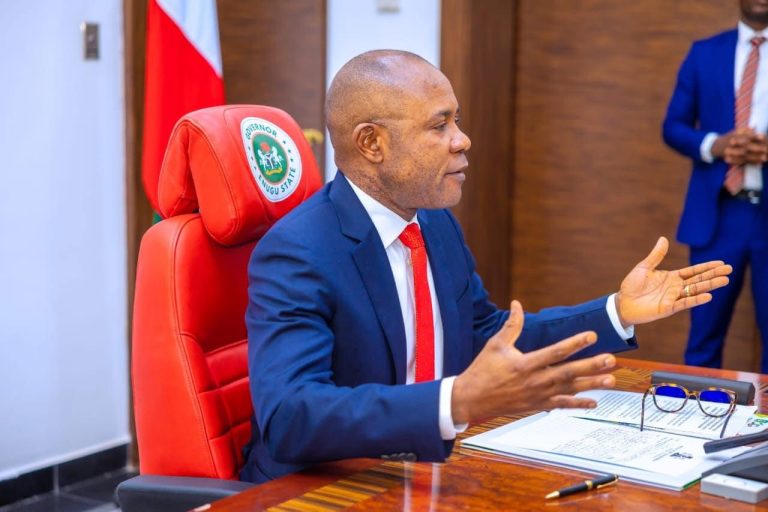
Enugu State Governor, Dr. Peter Mbah, has approved the appointment of 23 new Special Advisers and Senior Special Assistants.

The appointments were announced on Wednesday, August 19, 2026, in a statement signed by the Secretary to the State Government, Prof. Chidiebere Onyia. The appointments take effect immediately.

According to the statement, 9 persons were appointed as Special Advisers while 14 others will serve as Senior Special Assistants.

Some of the Special Advisers include Hon. Chukwudi Ezinwa on Labour Matters, Hon. Sunday Nnamani on Special Duties, Mr. Williams Chukwu on Agriculture, Prince Afam Agana on Infrastructure Compliance, and Humphrey Onyima on Investment Strategy and Public Relations.

Among the Senior Special Assistants are Pastor Kenneth Asogwa on Heritage and Community Relations, Barr. Lucky Chukwu on Public Affairs, Hon. Steve Odo on Tourism, Mrs. Eucharia Offor on Human Resource Management, and Kelvin Ede on Research and Strategy.

The government said the appointments are aimed at strengthening governance and boosting capacity in key areas such as agriculture, infrastructure, investment, rural development, tourism, and public communication.

*

Nsukka Council Boss hails Gov. Mbah For Providing Quality Healthcare, Education, Others

0

“We are grateful to His Excellency, Dr Peter Mbah for the massive developmental projects from health, education, roads, social interventions and a brand new teaching hospital in Nsukka axis of the state.

“We are also grateful to President Bola Tinubu and Gov. Mbah for making it possible for us to have now the first Vice-Chancellor of the University of Nigeria Nsukka (UNN) from Nsukka extraction.

“There is serious reconstruction work ongoing at the 9th Mile-Nsukka-Obollo Afor Dual Carriageway, which cut-across Nsukka LGA by the President Tinubu’s administration,” he said.


Furore Over Removal Of Bayelsa Council Boss, Assembly Must Obey Constitution, Court Orders, Demands Publisher

The Publisher of Niger Delta Herald, Mr. Francis Dufugha, on Wednesday condemned the purported removal of the Sagbama Local Government Area Chairman, Mrs Allen Tangi, by the Bayelsa State House of Assembly.

SummitNews recallsv that the Assembly on Tuesday approved the removal of Tangi and Sufade Tobi , Vice Chairman of Sagbama LGA over alleged gross misconduct.

The speaker of the House Hon Abraham Ingobere who announced this explained that it is in compliance with Section 22 Sub Section 6&7 of the Bayelsa State Administration Law of 2000 .

The development followed a petition against the Chairman on issues bothering on non-presentation of the monthly income and expenditure reports of the local government, non-presentation of annual budget before spending and failure to appear before the house.

Dufugha described the development as disturbing, particularly if it was carried out despite a subsisting court order restraining action against the council leadership.

He said no political office holder or institution was above the Constitution, the judiciary and the law.

“If that order was still valid and subsisting at the time of the Assembly’s action, then the issue is no longer merely political,” he said.

Dufugha said the development raised serious questions about obedience to judicial orders and respect for the rule of law in a constitutional democracy.

He maintained that the legislature was not above the law and warned against selective application of constitutional provisions for political advantage.

He also drew attention to Section 109 (1) (g) of the 1999 Constitution, as amended, which provides for vacation of a legislative seat in certain circumstances involving defection.

According to him, constitutional provisions should not be invoked against political opponents while being ignored when they affect political allies.

Dufugha said a court order remained binding until set aside by a competent court, emphasising that any disagreement with a judicial pronouncement should be addressed through lawful judicial processes.

He urged the Assembly to make public any allegations of gross misconduct against Tangi and allow her fair hearing in accordance with due process.

He said the people of Sagbama had a legitimate interest in the leadership of their local government and warned that the controversy could further heighten tension in the area.

Dufugha challenged the Assembly to demonstrate its independence as an institution of democracy and not give the impression that it was acting as a rubber stamp for any arm or faction of government.

He said lawmakers who knowingly violated a valid court order should be prepared to answer the constitutional and legal questions arising from their actions.

“Being a lawmaker does not confer immunity from the law. Indeed, lawmakers should be the first to obey the law because they are entrusted with making laws for everyone else,” he said.

Dufugha called on the Assembly and other relevant authorities to respect the judiciary and ensure that all actions concerning the Sagbama council leadership complied with the Constitution and other applicable laws.

He warned political office holders against placing political expediency above democratic institutions, saying political power was transient while institutions of democracy must endure.

“The law must not bend because the powerful are involved,” Dufugha said.
Taingi’s ordeal is believed to be tied to her refusal to join Gov Diri and his political allies in defecting to the All Progressives Congress.

ECHOES OF TRAUMA: The Escape We Don’t See – By Lillian Okenwa

0

_
_*Some people are not looking for pleasure. They are looking for a way to make the pain stop.**

By Lillian Okenwa*_

WE see the bottle, the powder, the pills, the gambling account, the hours disappearing into a phone. We see the escape. We may never see what drove someone to it.

The escape is visible. The pain that produced it often isn’t.

Not everyone who reaches for a substance is looking for a high. Some want sleep. Others want a few hours without the thoughts that will not stop racing.

. Some are searching for courage. Others want to forget. There are people who have simply become desperate for a few moments in which life feels different from what it has become.

And some are trying to get away from themselves. What happened before the escape began?

There may have been a death, a divorce, an abusive home, a business that collapsed, a job that never came, years of rejection, a childhood nobody talks about or a relationship that left wounds no one could see.

Read Also: Echoes of Trauma: When hope refuses to leave

Read Also: Echoes of Trauma: When nobody is listening.

There may not have been one dramatic event. Life may simply have delivered too many disappointments, one after another, until a person began searching for somewhere to put the pain.

Nigeria is confronting its drug problem with increasing urgency. The National Drug Law Enforcement Agency (NDLEA) continues to pursue trafficking networks, seize illicit substances and arrest suspected dealers and kingpins.

The Federal Government has also reaffirmed its commitment to prevention, enforcement, treatment and rehabilitation.

The work is necessary.

Those who make money from another person’s vulnerability must be pursued. Networks supplying dangerous substances must be disrupted. Children and young people must be protected from those who deliberately put drugs within their reach.

Yet there is another person in this picture.
The person buying.
The person hurting.
The person who has reached a point where temporary relief looks easier to bear than another ordinary day.

What happens when we remove the escape but leave the pain?

A dealer and a person struggling with dependence cannot be placed in the same box. The dealer exploiting another person’s vulnerability deserves accountability.

The young person taking drugs to cope with an unbearable home may need treatment, counselling, safety, family support and a way back into ordinary life.

One is a criminal-justice question. The other is a health question.
And sometimes, it is a trauma question.

We have become more comfortable talking about mental health, yet many people still do not know what to do when someone is actually struggling.

We tell people to be strong. We tell them to pray. We tell them to think positively. We tell them other people have it worse. We tell them to stop worrying. We tell them to move on.

Most of the time, we mean well.

Yet a person drowning does not need another speech about the importance of swimming. They need somebody to notice that they are drowning.

Depression does not always arrive with tears. It can look like irritability, excessive sleeping or sleeplessness. It can hide behind relentless work, gambling, drinking, endless hours online or the repeated use of something that promises temporary relief.

None of these behaviours automatically means that someone is depressed or traumatised. Depression does not inevitably lead to substance use. Psychological distress and substance-use problems can, however, overlap, and both require proper care rather than shame or dismissal.

None of this removes personal responsibility. Choices have consequences. Families suffer. Children suffer. Communities suffer. Lives are lost.

When everyone who is struggling is labelled bad, irresponsible or simply undisciplined, however, we may drive the person further underground and miss the pain underneath the behaviour

r A young person using drugs may need accountability, but he may also need treatment, counselling, safety and someone willing to understand what brought him there. Telling him simply to stop may remove the coping mechanism without touching the wound underneath it.

Think of the young person who comes home from school and finds his parents fighting every night

The graduate who has been looking for work for three years

The widow trying to raise children alone.
The man whose business collapsed and who cannot bring himself to tell his friends that he has run out of money.

The woman who has spent years in a marriage that has slowly destroyed her confidence.

The teenager being bullied who has stopped telling anyone.

The person who lost someone and never had the opportunity to grieve.

The person who looks successful from the outside and feels like a failure every time the door closes behind them.

What do we offer such people before they reach for something that promises relief?
Prevention has to mean more than telling people that drugs are dangerous.
Of course they are.

We also need places where people can talk before they break. Schools where troubled children are noticed. Families where admitting that you are struggling does not attract ridicule

Workplaces where psychological distress is not treated as weakness. Communities where people know where to seek help. Healthcare systems where mental-health care is not reserved for those who can afford it.

We need friendships in which someone can say, “I don’t think you are okay,” and stay long enough to hear the answer.

Nigeria has made efforts to strengthen its mental-health response, including integrating mental-health services into broader public-health programmes and giving greater attention to young people. The question is how quickly and how widely those efforts reach the person sitting alone in a room at 2 a.m., wondering how to survive the next day.

That person may never attend a conference. They may never walk into a government office. They may never tell anyone, “I am depressed.” They may simply begin looking for an escape.

And the escape may be much easier to find than help.

We often notice addiction after it has become visible: when the child begins failing, the employee stops showing up, money disappears, a marriage starts collapsing, the police arrive or the hospital becomes involved.

By then, the story may have started years earlier.

There may have been a moment when someone was hurting and nobody noticed. A season when help was needed but asking felt impossible. A child who learnt early that nobody wanted to hear about his pain. An adult who became so accustomed to carrying everything alone that seeking help began to feel like failure.

By the time the escape becomes visible, the pain may have been there for years.

The fight against drugs therefore has to extend beyond the supply chain. Enforcement remains essential. So are prevention, treatment, rehabilitation and reintegration. Just as important is learning to see people before they become cases.

Help has to be accessible, affordable and trusted enough for people to reach it before desperation pushes them somewhere else.

A person we call difficult may be grieving. Someone we call lazy may be depressed. The one we dismiss as irresponsible may be overwhelmed. A troublesome teenager may be carrying something he has never learnt how to name.

We cannot assume this about everyone. We can, however, become curious before becoming judgmental. Instead of asking only: Why would anyone do this to themselves? Perhaps we should also ask: What happened that made this feel like the best escape available?

There is no simple answer. Human beings are complicated. Pain is complicated. Addiction is complicated. Depression is complicated. A society cannot arrest its way out of human pain. It can disrupt the supply, prosecute traffickers, seize drugs and dismantle criminal networks. All of that is necessary.

Somewhere, another person will still wake up tomorrow carrying a pain they do not know how to carry. If there is nowhere to take that pain, something else may eventually offer to carry it for them.

Not everything that offers relief is a friend.

Some things only postpone the pain while making the eventual cost heavier. The work, then, is not merely to make escape harder. It is to make help easier to find. To make conversation safer. To make treatment less shameful. To make mental-health care more accessible. To teach our children that asking for help is not weakness.

And to remember that the person who appears to be falling apart may have spent a very long time holding themselves together.

The escape is visible. The pain that produced it often isn’t.

Somewhere between the two is a person we may still have time to reach. Before the escape becomes an addiction. Before the addiction consumes a life. Before the life becomes a statistic. Perhaps we should look again and ask: What are you trying to escape from?

That may be where the real conversation begins.

_*A lawyer and equity advocate, Lillian is the publisher of Law & Society Magazine. She can be reached at Lillianokenwa@gmail.com. X: @OkenwaLillian.*_


Police begin probe into death of Ebonyi man amid political tension. -From-Paulinus Ogbonna

The Ebonyi Police Command has commenced investigation into the death of Amos Ubochi, whose lifeless body was discovered along a bush path in the state.

The command, in a statement issued on Wednesday by its Police Public Relations Officer (PPRO), SP Joshua Ukandu, said Ubochi left his residence on Aug. 17 but did not return.

Ukandu said the command received information on Aug. 18 that the deceased’s body had been discovered along a bush path within the community.

“Upon receiving the report, Police operatives visited the scene, and evacuated the body to the Federal Teaching Hospital, Abakaliki, where he was confirmed dead,” he said.

The PPRO said the command had commenced a comprehensive investigation to unravel the circumstances surrounding the death and identify those responsible.

“The Command assures members of the public that every necessary step will be taken to get to the root of the incident,” Ukandu said.

He urged anyone with useful information that could assist the investigation to come forward.

“Anyone with useful information that could assist the investigation” should make such information available to the police, he added.

The police statement did not establish the motive for the killing or confirm whether it was politically motivated.

However, the incident has raised concerns coming at a time of increasing political activities ahead of the 2027 general elections.

The command assured members of the public that the investigation would be comprehensive and aimed at uncovering the circumstances surrounding Ubochi’s death.

It also appealed to residents to cooperate with investigators by providing credible information that could lead to the identification and arrest of those responsible.